
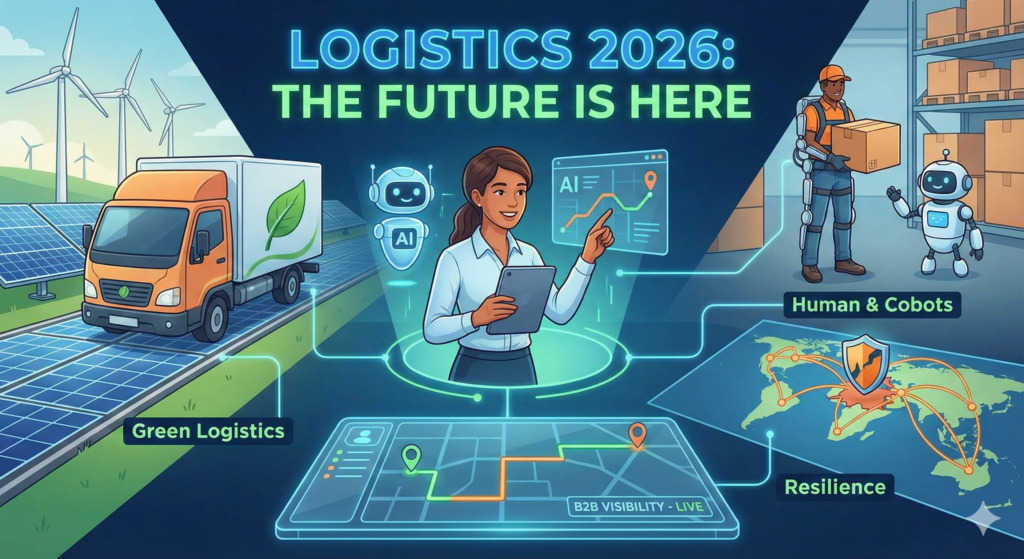
The Future of Moving Things: 5 Logistics Trends That Will Define 2026
If you work in logistics, you know that the only constant is change. One day it’s a port strike, the next it’s a fuel price hike, and the day after that, a customer wants a package delivered in 10 minutes.
As we settle into 2026, the industry is shifting again. We aren’t just moving boxes anymore; we are managing data, fighting climate change, and navigating a complex global economy. The “old ways” of doing business—pen, paper, and phone calls—are fading fast.
But don’t worry. This isn’t a sci-fi movie where robots take everyone’s jobs. In fact, 2026 is shaping up to be the year where technology finally starts helping us rather than just confusing us.
Here are the top 5 logistics trends that will define this year, and more importantly, how you can use them to grow your business.
1. AI Grows Up: From “Chatbot” to “Co-Pilot”
For the last few years, everyone has been talking about Artificial Intelligence (AI). Until now, AI was mostly “Predictive.” It would look at a map and say, “Hey, there is traffic on this route, your truck might be late.” That was helpful, but you still had to fix the problem yourself.
In 2026, we are entering the era of “Agentic AI.”
What is it?
Think of Agentic AI as a highly skilled co-pilot. Instead of just telling you about a problem, it fixes it for you (with your permission).
For example:
- The Old Way: The system alerts you that a shipment from Mumbai to Delhi is delayed because of a breakdown. You have to call the driver, find a new truck, and email the customer.
- The 2026 Way: The AI sees the breakdown. It automatically checks available trucks nearby, books a transfer, updates the route, and sends a polite WhatsApp message to the customer updating the ETA—all before you even finish your morning coffee.
Why it matters
This is a game-changer for small logistics companies. You don’t need a team of 50 dispatchers anymore. You need a smart system that acts as your operations team.
What you should do
Don’t be afraid of software. If you are still running your transport business on Excel sheets, 2026 is the year to stop. Look for Transport Management Systems (TMS) that offer “automated resolution,” not just “tracking.”
2. Green Logistics: No Longer Just “Nice to Have”
A few years ago, “sustainability” was something only giant companies like Unilever or Amazon cared about. Small players thought, “I can’t afford electric trucks, so this doesn’t apply to me.”
In 2026, that mindset is dangerous. Green logistics is no longer about saving the planet; it’s about saving your contracts.
The Shift
Governments are tightening regulations. In India and globally, there are stricter rules on carbon emissions (often called ESG compliance). Big clients are now demanding “Carbon Reports” from their logistics partners. If you want to ship goods for a large retail brand, they will ask: “What is the carbon footprint of this delivery?” If you can’t answer, you lose the contract.
The “Circular” Economy
We are also seeing a massive rise in Reverse Logistics (handling returns). In 2026, companies aren’t just dumping returned items. They are repairing, recycling, or restocking them to reduce waste.
What you should do
- Start Measuring: You don’t need to buy an electric fleet tomorrow. Start by tracking your fuel efficiency.
- Optimize Packaging: If you offer packaging services, stop using excessive bubble wrap. Switch to honeycomb paper or recycled cardboard. It’s cheaper and clients love it.
- Route Optimization: The greenest mile is the mile you don’t drive. Use software to ensure your drivers are taking the most efficient route. It saves fuel (money) and carbon (planet).
3. Resilience: The “China Plus One” Strategy Hits Home
We all remember the chaos of the past few years. Factories shut down, ships got stuck, and shelves went empty. The lesson learned? Never rely on one source.
In 2026, the buzzword is “Resilience.”
Friend-shoring and Near-shoring
Companies are moving manufacturing closer to where they sell. For India, this is huge. We are seeing a boom in manufacturing as global companies look for alternatives to China (the “China Plus One” strategy).
This means logistics patterns are changing. Instead of everything coming from a single port in Asia to a single warehouse, supply chains are becoming a web. Goods are moving from Vietnam, India, and Mexico to local hubs.
The Rise of Micro-Warehousing
To protect themselves from disruptions, companies are storing stock in multiple small warehouses rather than one giant one. If a flood closes one warehouse, the others keep working.
What you should do
If you are a warehouse provider or transporter, focus on flexibility.
- Don’t lock clients into rigid long-term contracts that scare them. Offer flexible storage options.
- If you are a transporter, diversify your routes. Don’t rely 100% on one highway or one type of cargo.
4. The Human Element: Technology for the “Frontline”
There is a massive shortage of skilled labor in logistics. Truck drivers are retiring, and young people aren’t rushing to replace them. Warehouse staff turnover is high because the work is hard.
In 2026, technology is finally being used to make the worker’s life easier, not just the manager’s life.
Cobots (Collaborative Robots)
We aren’t seeing warehouses run entirely by robots yet. Instead, we are seeing “Cobots.” These are machines that work alongside humans.
- A “Follow-Me” bot might carry the heavy box while the human picker walks freely to the next shelf.
- Exoskeletons (wearable support suits) are being used to help workers lift heavy loads without hurting their backs.
Gamification
To keep younger workers engaged, logistics apps are looking more like video games. Drivers get “scores” for safe driving. Warehouse pickers earn badges for accuracy. It sounds silly, but it works to improve retention and morale.
What you should do
Treat your drivers and staff like gold. In 2026, the companies that win will be the ones that can keep their staff.
- Invest in ergonomic tools that make lifting easier.
- Use simple, user-friendly apps for your drivers. If your driver app is hard to use, they will leave.
5. The “Amazon Effect” on B2B Logistics
For a long time, there was a difference between B2C (delivering to a home) and B2B (delivering to a business).
- B2C: “Your pizza will be there in 15 minutes, track it on this map.”
- B2B: “Your truckload of steel will arrive sometime on Tuesday. Maybe.”
In 2026, that difference is dead. Business owners are also consumers. If they can track their Swiggy order in real-time, they expect to track their ₹50 Lakh shipment in real-time too.
Visibility is King
“Where is my stuff?” is the most expensive question in logistics because it wastes time. 2026 is the year of Hyper-Visibility. Sensors are becoming dirt cheap. We can now put trackers not just on the truck, but on the pallet or even the individual box.
Dynamic ETAs
Static delivery times are gone. We now use “Dynamic ETAs” that update every minute based on real-world traffic and weather.
What you should do
If you run a logistics company, your “Customer Portal” is just as important as your trucks.
- Give your clients a login where they can see their goods.
- Stop sending emails with Excel attachments.
- If you can’t afford a custom app, use WhatsApp Business API to send automated tracking links.
Conclusion: Adapt or Get Left Behind
The logistics industry in 2026 is exciting, but it is also unforgiving. The gap between the “Digital” companies and the “Traditional” companies is getting wider.
The good news? You don’t need millions of dollars to adapt.
- You can use AI tools that cost a few hundred rupees a month.
- You can adopt green practices by simply planning better routes.
- You can improve retention just by listening to your drivers.
The future of logistics isn’t about who has the biggest trucks. It’s about who has the smartest operations.
Over to you: Which of these trends are you seeing in your daily work? Are you excited about AI, or worried about the changes? Let me know in the comments below!