
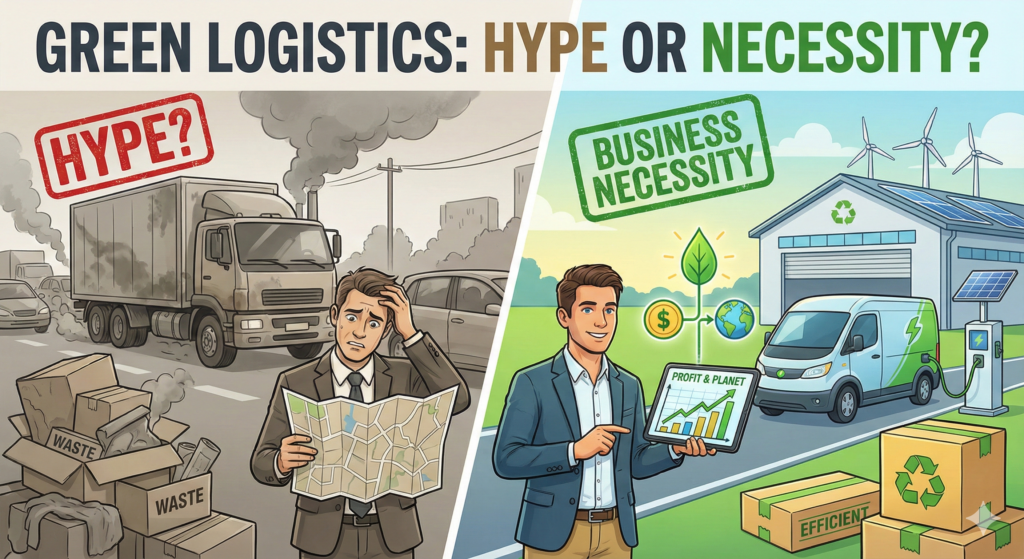
Green Logistics: Is it Just Hype or a Business Necessity?
Let’s be honest. When you hear the phrase “Green Logistics” or “Sustainability,” what is the first thing that comes to your mind?
If you are like many business owners or transport managers I talk to, you might roll your eyes. You might think:
- “Oh great, another expensive marketing gimmick.”
- “That’s fine for giant companies like Amazon or DHL, but I’m just trying to pay my drivers and keep the lights on.”
- “Sounds nice, but electric trucks cost a fortune and there are no charging stations anyway.”
If that’s how you feel, I get it. For a long time, “going green” in logistics felt like a luxury. It was something you put in a glossy brochure to impress people, but it didn’t really change how you moved boxes from point A to point B. It felt like hype.
But I am here to tell you that something has changed in the last few years. The wind has shifted.
In 2026, Green Logistics is no longer just about saving the polar bears or hugging trees. It’s about saving your business. It has moved from “nice to have” to “must-have.”
If you are still treating sustainability as just hype, you are facing a massive financial risk. Here is the honest truth about why green logistics is now a business necessity, and what it actually means for you (without the complicated jargon).
Phase 1: Why Were We Skeptical? (The “Hype” Years)
To understand where we are today, we have to admit that the skepticism was justified.
Ten or fifteen years ago, the technology just wasn’t ready.
- Electric vehicles (EVs) couldn’t carry heavy loads very far.
- Alternative fuels were incredibly expensive and hard to find.
- Sustainable packaging was flimsy and didn’t protect the products.
Furthermore, there was a lot of “Greenwashing.” Companies would paint a leaf on their logo and claim they were saving the planet, while their actual operations hadn’t changed at all. It made everyone cynical. It made “sustainability” feel like a lie designed to charge customers more money.
For the average transporter or warehouse owner in places like Mumbai or Delhi, focusing on survival was harder enough without worrying about carbon footprints.
Phase 2: The Reality Check (What Changed?)
So, what happened? Why am I saying it’s urgent now?
Three massive forces collided at the same time: Customers, Governments, and Technology.
1. The Customer Demand Shift
This is the biggest driver. A few years ago, customers only cared about two things: “How fast can I get it?” and “How cheap is shipping?”
Now, there is a third question: “How much waste does this create?”
It started with regular consumers (B2C). People got sick of ordering a small USB drive and receiving it in a shoebox filled with plastic bubble wrap. They started complaining on social media.
But the real shift is now happening in Business-to-Business (B2B).
If you are a logistics provider hoping to win a contract with a large multinational company (like a Unilever, Tata, or Reliance), they won’t just look at your price. They will send you a 50-page questionnaire asking about your emissions.
Why? Because they have made public promises to reduce their carbon footprint. They can’t hit their goals if their logistics partners are dirty. If you can’t show them how you are being greener, they literally cannot hire you.
2. The Government Hammer
Governments worldwide are done asking nicely. They are starting to demand change. We are seeing stricter emission norms for vehicles. We are seeing bans on certain types of single-use plastics in packaging.
In many cities globally, we are seeing “Low Emission Zones” where older, dirty diesel trucks have to pay a heavy fee just to enter the city center. If your fleet isn’t ready, your delivery costs just doubled.
3. Technology Caught Up
Finally, the tools actually work now. Route optimization software used to require a PhD to understand. Now, it’s an app on a phone that costs a few hundred rupees a month. EV battery ranges have improved massively for last-mile deliveries.
The Financial Argument: Green = Lean
Forget about the environment for a second. Let’s talk about cold, hard cash.
The biggest misconception about green logistics is that it always costs more money. The truth is, green logistics is usually just another word for efficiency.
Think about it. What is pollution in logistics? It’s mostly burned fuel and wasted materials.
- If your driver gets lost and drives an extra 10 kilometers, they have burned unnecessary diesel (pollution) and wasted time (money).
- If you use a box that is too big and fill it with plastic filler, you have used unnecessary materials (pollution) and paid to ship “air” because the box takes up more space in the truck (money).
The most eco-friendly mile is the mile you never drive.
When you use software to plan better routes, you reduce your fuel bill by 15%. That is green logistics.
When you train drivers to stop idling their engines while waiting, you save fuel. That is green logistics.
When you switch to the right-sized packaging, you can fit more boxes in a truck, meaning fewer trips. That is green logistics.
Suddenly, being “green” isn’t an extra cost; it’s a cost-cutting strategy.
Practical Steps for the “Little Guy”
Okay, so you understand the need. But if you are a small business, you can’t just go out and buy 50 electric trucks tomorrow.
The good news is, you don’t have to. Green logistics is a journey, not a light switch. Here are three practical, low-cost ways to start today:
1. Rethink Your Packaging
This is the easiest win. Are you shipping small items in big boxes? Stop it.
Invest in a wider variety of box sizes. Look into honeycomb paper wrap instead of plastic bubble wrap—it’s often cheaper, protects just as well, and customers appreciate that it’s recyclable paper.
2. Get Serious About Route Optimization
If you are still planning delivery routes using Google Maps and guesswork, you are lighting money on fire.
Invest in a basic Transport Management System (TMS) or route planning software. These tools ensure your vehicles drive the shortest distance possible, avoid traffic jams, and don’t overlap routes. It’s better for the air, and much better for your fuel wallet.
3. Focus on Maintenance (The Boring Stuff)
A poorly maintained truck pollutes more and burns more fuel. It’s that simple.
- Are your tires properly inflated? Under-inflated tires increase fuel consumption significantly.
- Are engines tuned?
Regular, proactive maintenance is one of the “greenest” things you can do because it ensures your existing equipment runs as efficiently as possible.
Conclusion: The Train is Leaving the Station
If you are still sitting on the fence, thinking green logistics is just hype, I have a warning for you: You are about to get left behind.
The companies that will thrive in 2026 and beyond aren’t necessarily the ones who care the most about the planet. They are the ones who realize that efficiency, customer demands, and environmental responsibility are now the exact same thing.
You don’t have to save the world overnight. But you do need to start measuring your impact and making small changes to reduce waste.
Green logistics isn’t hype. It’s the new baseline for doing business. The question isn’t if you will adapt, but when.
What’s your take? Are you finding clients asking more about sustainability, or is price still the only thing that matters in your market? Let me know in the comments.