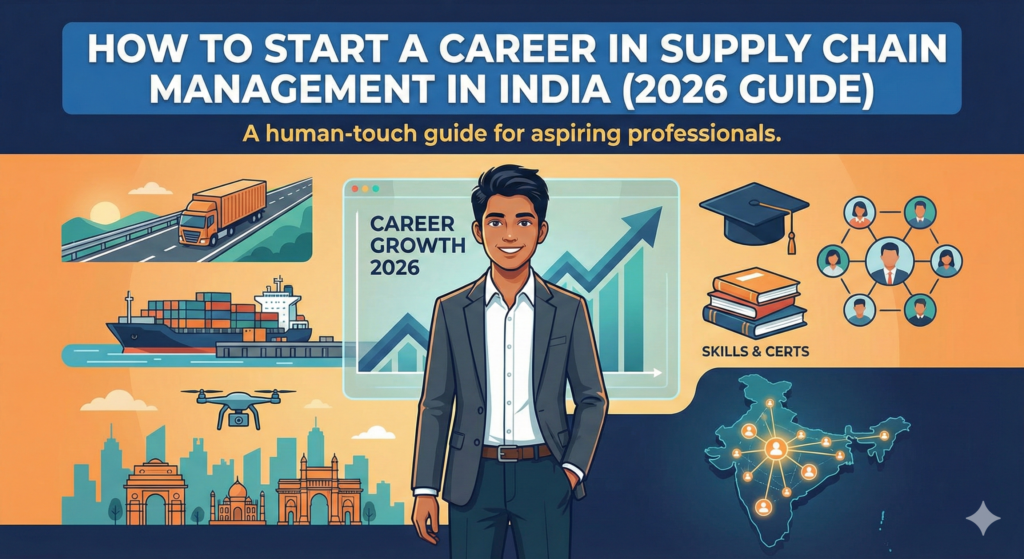
How to Start a Career in Supply Chain Management in India (2026 Guide)
Picture this: You order a charger for your phone on Blinkit or Zepto, and it arrives in 12 minutes. You track your Swiggy order and see the driver turn the corner. You walk into a D-Mart, and the shelves are magically full of exactly the biscuits you like.
We take these things for granted. But behind every single one of those “magic” moments is a person. A person who planned the route, negotiated the price, stored the stock, and managed the delivery.
That person is a Supply Chain Manager.
If you are reading this, you are probably thinking about joining this world. Maybe you are a fresh graduate wondering if this is a good path. Maybe you are working in sales or customer service and want a change.
I have good news for you: There has never been a better time to enter Supply Chain Management (SCM) in India than right now, in 2026.
The industry is booming. Salaries are rising. And contrary to what people think, it is not just about driving trucks or lifting boxes in a dusty godown. It is about data, technology, and strategy.
So, how do you actually get started? Do you need a fancy MBA? Do you need to be a math genius?
Here is your no-nonsense, step-by-step guide to launching your career.
Step 1: Break the Myth (What is SCM, really?)
First, let’s clear up a misunderstanding. Supply Chain is not just “Logistics.”
- Logistics is moving things (Transport & Warehousing).
- Supply Chain is the entire brain. It starts when a company buys raw materials (Procurement), goes through manufacturing, inventory planning, and ends when the customer gets the product (and even returns it).
In 2026, a Supply Chain professional in India is less like a traffic cop and more like a Business Architect. You are the one saving the company money and keeping customers happy.
Step 2: Education – Do You Need an MBA?
This is the most common question I get: “Sir, do I need an MBA in Operations to get a job?”
The honest answer? It helps, but it is not mandatory for entry-level roles.
The “Degree” Route
If you have the time and money, an MBA in Operations or Supply Chain Management (from institutes like NITIE/IIM Mumbai, SP Jain, or Symbiosis) is a golden ticket. It will land you directly in management trainee roles at big companies like HUL, Amazon, or Tata.
The “Skills” Route (For everyone else)
If you don’t have an MBA, don’t panic. In 2026, companies value skills over degrees. You can enter the industry with any graduation degree (B.Com, B.Tech, B.Sc) if you have the right certifications.
- APICS (ASCM): This is the global gold standard (CPIM or CSCP), but it is expensive.
- Indian Certifications: Look for courses from IIMM (Indian Institute of Materials Management) or online certifications from platforms like Coursera/UpGrad that focus specifically on Data Analytics in Supply Chain.
Step 3: Master the “Big 3” Skills
You can have a shiny degree, but if you can’t do the work, you won’t last. To get hired in India today, you need these three skills:
1. Excel (The King)
I cannot stress this enough. Supply chain runs on Excel. You need to know VLOOKUP, Pivot Tables, and basic Macros like the back of your hand. If you are good at Excel, you are already ahead of 50% of the candidates.
2. Data Fluency
You don’t need to be a coder. But you need to be comfortable looking at a dashboard (like PowerBI or Tableau) and understanding what it says. Can you look at a sales report and say, “Hey, demand for ACs is rising in Pune, we need to move stock there”?
3. “Desi” Communication
This is the hidden secret of Indian logistics. You will be talking to everyone—from a polished CEO in a boardroom to a truck driver on a highway in Haryana. You need to be able to switch languages and tones instantly. If you are too “corporate” to talk to a warehouse supervisor, you will fail.
Step 4: Where to Apply? (Pick Your Lane)
In India right now, there are three main types of employers. Pick the one that fits your personality:
- The E-Commerce Giants (Amazon, Flipkart, Meesho):
- Pros: Best technology, fast learning, good brand name.
- Cons: Very high pressure, long hours.
- The “Quick Commerce” Startups (Blinkit, Zepto, Swiggy Instamart):
- Pros: Exciting, fast-paced, hiring aggressively in 2026.
- Cons: Chaotic, “burnout” culture is real.
- Traditional Manufacturing (Tata, Maruti, Godrej, FMCG):
- Pros: Stable, good work-life balance, structured learning.
- Cons: Slower growth, older technology (sometimes).
Entry-Level Job Titles to Search For: Don’t just search for “Manager.” Look for these roles on Naukri or LinkedIn:
- Supply Chain Analyst
- Logistics Coordinator
- Procurement Executive
- Inventory Planner
- Warehouse Operations Executive
Step 5: The “Insider” Trick to Getting Hired
Sending resumes on websites often feels like throwing paper into a black hole. Here is how to actually get noticed:
Network where the work happens. Go to LinkedIn and search for “Supply Chain Manager” in your city (Mumbai, Delhi, Bangalore). Connect with them. Send a personalized note: “Hi, I am an aspiring SCM professional. I see you work at Xpressbees. I admire how you handle last-mile challenges. I would love to follow your posts.”
Don’t ask for a job immediately. Build a connection.
Also, look for Internships. Even a 3-month unpaid internship at a small courier company or a local warehouse is worth more than a 3-year degree where you never saw a real truck. Experience is everything.
Conclusion: Just Start
The Supply Chain industry in India is hungry for talent. We have the technology, we have the demand, but we don’t have enough smart, dedicated people to run the show.
It is a career where every day is different. One day you are solving a packaging issue, the next you are routing vehicles for a festival sale. It is stressful, yes. But it is also incredibly satisfying to see a physical product reach a customer’s hands and know, “I made that happen.”
So, fix up that resume, learn those VLOOKUPs, and get out there. The industry is waiting for you.
Need help with your resume? Drop a comment below and I’ll share a template for a Supply Chain fresher!