
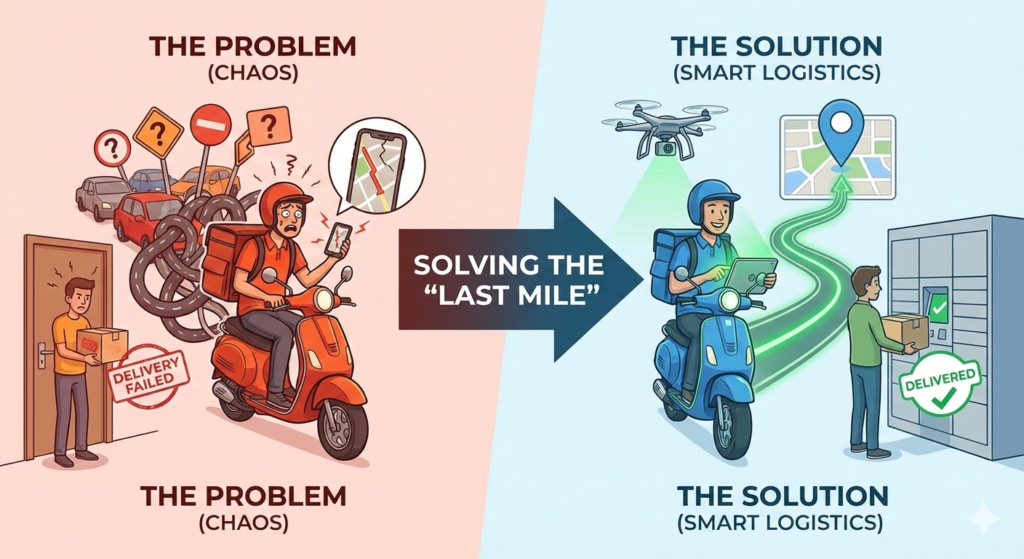
Solving the ‘Last Mile’ Problem: Why Delivery Failures Happen
We have all been there.
You order something online—maybe a birthday gift for your daughter or a new gadget you have been saving up for. You track it obsessively. The app says “Out for Delivery.” You wait at home all day. You don’t even take a shower because you are afraid you might miss the doorbell.
Then, at 8:00 PM, your phone buzzes.
“Delivery Attempt Failed: Customer Not Available.”
You stare at the phone in disbelief. You were home! The doorbell never rang! No one called you! Rage takes over. You call customer service, you tweet at the company, but the damage is done.
For you, it is a moment of frustration. But for a logistics company or an e-commerce seller, this is a disaster. This is the “Last Mile Problem.”
In the logistics world, the “Last Mile” is the final journey of a package from the local distribution hub to the customer’s doorstep. It is the shortest part of the journey, but it is also the most expensive, the most complicated, and the most heartbreaking.
Why is it so hard to just hand a box to a person? Why do delivery failures really happen? And more importantly, how do we fix it in 2026?
Let’s dive deep into the messy reality of the Last Mile.
Part 1: The “Why” (The Real Reasons Deliveries Fail)
If you think delivery failures happen simply because drivers are lazy, you are missing the bigger picture. The reality is a complex mix of bad data, chaotic cities, and human behavior.
1. The “Indian Address” Puzzle
In the US or Europe, an address is simple: 123 Main Street, Apt 4B. In India, an address often looks like this: “Behind the yellow temple, near the big banyan tree, opposite Sharmaji’s Sweet Shop, 2nd floor, blue gate.”
This is a nightmare for technology. Google Maps is great, but it often stops at the main road. It doesn’t know where the “yellow temple” is.
- The Failure: The driver reaches the “pin” location on the map, which is actually 500 meters away from the actual house. He wanders around for 10 minutes, gets frustrated, has 50 other packets to deliver, and eventually marks it as “Address Not Found.”
2. The “Fake Attempt” Phenomenon
This is the one that makes customers the angriest. Why do drivers mark “Customer Not Available” without even visiting?
- The Reality: It is rarely laziness; it is usually pressure. A driver has to deliver 80–100 packets in a single shift. That gives them about 4-5 minutes per delivery, including travel time. If they get stuck in traffic for 20 minutes, or if their bike breaks down, they mathematically cannot finish their route.
- The Failure: To avoid a penalty from their supervisor for “undelivered packets,” they mark the remaining 5 packets as “Customer Not Available” to buy themselves another day. It’s a systemic failure, not just a personal one.
3. The “Cash on Delivery” (COD) Trap
India loves Cash on Delivery. But COD is the biggest enemy of the Last Mile.
- The Scenario: The rider arrives. The customer says, “Oh, I don’t have cash right now, come back tomorrow” or “I changed my mind, I don’t want it anymore.”
- The Failure: The rider has wasted fuel, time, and effort for zero result. This is called an RTO (Return to Origin). It costs the seller money to ship it there and ship it back.
4. The “Ghost” Customer
Sometimes, the customer is the problem.
- They put their office address but the delivery comes on a Sunday.
- They put their home address but they are at work.
- They don’t answer calls from unknown numbers (thinking it’s spam). If the rider can’t call you and can’t find your house, that package is going back to the hub.
Part 2: The Solutions (How We Fix It in 2026)
Okay, enough about the problems. As logistics professionals (and business owners), we are paid to solve problems. The good news is that 2026 has brought us some incredible tools to fix the Last Mile.
Here is how smart companies are winning the battle.
1. “Pin” It to Win It (Geocoding)
Stop relying on text addresses. The Fix: Modern logistics apps now require the customer (or the first driver who visits) to drop a precise “Pin” on the map.
- How it helps: The next time a driver goes there, they aren’t looking for a “yellow temple.” They are following a GPS dot that leads them exactly to the blue gate. This increases First Attempt Delivery rates by almost 20%.
2. WhatsApp is the New Phone Call
Nobody answers phone calls anymore. The Fix: Automated WhatsApp bots.
- The Workflow: At 8:00 AM, the system sends a WhatsApp message: “Your package is coming today. Are you home?”
- The Options: The customer can click buttons like: “Yes, deliver it,” “Leave at Security,” or “Deliver Tomorrow.”
- The Result: If the customer says “Tomorrow,” the driver doesn’t even load that packet onto his bike. He saves space, fuel, and time.
3. The Rise of the “Kirana Network”
You are not home? No problem. The Fix: Using local Kirana stores as “micro-hubs.”
- How it works: Logistics companies are paying local shopkeepers a small fee to accept parcels. If you aren’t home, the driver drops it at the chemist or general store downstairs. You get an OTP and pick it up when you return from work.
- Why it wins: The driver gets a 100% delivery success rate. You get your package safely. The Kirana store owner gets footfall and a small commission. Everyone wins.
4. Route Optimization (AI vs. Traffic)
A human supervisor cannot plan a route for 50 drivers in Mumbai traffic. The Fix: Artificial Intelligence.
- How it works: AI software (like Locus or FarEye) analyzes traffic patterns, road widths, and delivery slots. It tells the driver: “Deliver packet A, then packet C, then packet B.”
- It knows that “MG Road is jammed at 5 PM,” so it routes the driver to a different area during that time. This reduces the driver’s stress and ensures they finish on time.
5. Incentivizing the “Human” Element
Technology is great, but the Last Mile is still human. The Fix: Better pay structures.
- Smart companies are moving away from “per packet” pressure that forces drivers to lie. They are adding “Customer Satisfaction Bonuses.” If a driver gets a 5-star rating from you, they earn extra. This motivates them to wait that extra 2 minutes for you to reach the door.
Part 3: What Can You Do? (For Business Owners)
If you are a business owner reading this, you might be thinking, “I can’t afford AI robots!”
You don’t have to. Here are three simple things you can do today to reduce your delivery failures:
- Validate Addresses at Checkout: Use a free plugin on your website that checks if a PIN code matches the city. Don’t let customers type “Mumbai, 110001” (which is a Delhi code).
- Add a “Landmark” Field: Make it mandatory. That one text field saves countless phone calls.
- Brand Your Packaging: If a customer sees a brown box, they might reject it. If they see a beautiful box with your logo, they are excited to receive it. Emotion plays a huge role in reducing rejections.
Conclusion: The Final Mile is the Only Mile that Matters
You can have the best product in the world. You can have the fastest trucks and the biggest warehouses. But if that final handover fails—if that “Last Mile” breaks—your customer doesn’t care about the rest.
Solving the Last Mile isn’t just about moving boxes faster. It’s about bridging the gap between a digital promise and a physical reality. It’s about understanding that behind every “Order ID” is a person waiting for a gift, a necessity, or a joy.
By using better data, respecting the drivers, and communicating clearly, we can turn “Delivery Attempt Failed” into “Delivered Successfully.”
And that is the only metric that truly counts.
Over to you: What is your worst delivery horror story? Did a package ever vanish into thin air? Share your story in the comments below—I read every single one!