
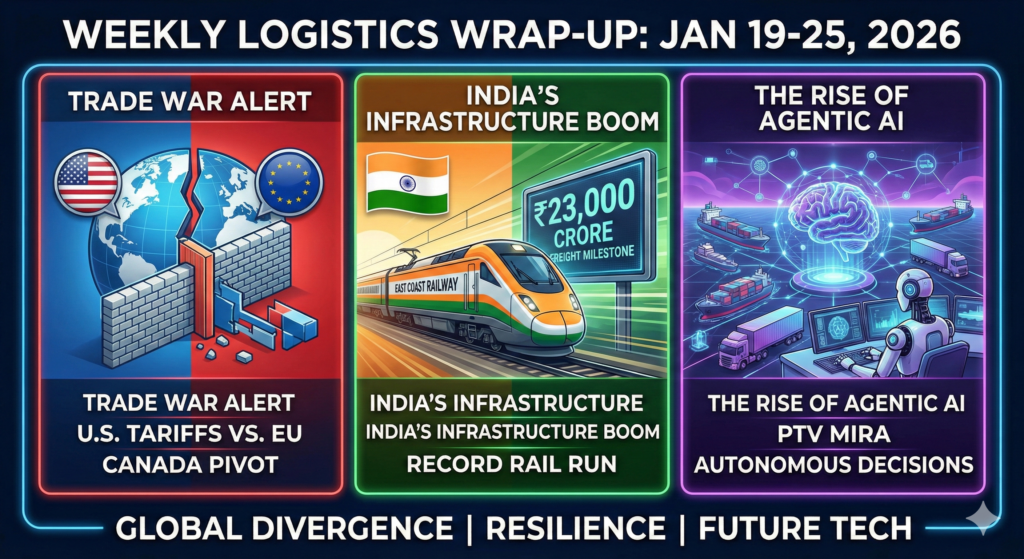
The Week in Logistics: Geopolitical Shockwaves, Indian Milestones, and the Rise of “Agentic” AI
Here is a detailed summary of the week’s biggest logistics news headlines for the week ending January 25, 2026.
Weekly Wrap-Up: January 19 – January 25, 2026
If there is one word to describe the third week of January 2026, it is “divergence.”
On one side of the globe, we saw the supply chain world dragged back into the volatile politics of the past, with trade wars and tariffs dominating the headlines from Washington and Brussels. On the other side, particularly in India and the technology sector, the narrative was entirely about future growth, record-breaking efficiency, and the dawn of a new era in Artificial Intelligence.
For logistics professionals, this week served as a stark reminder: we are operating in a world where a political tweet can disrupt a trade lane as easily as a hurricane, but where new tools are finally giving us the agility to respond.
Here is a comprehensive summary of the stories that defined the logistics landscape this week.
1. Global Trade: The “Greenland” Rift and the Canada Pivot
The biggest story of the week—and perhaps the month—was the sudden and sharp escalation in trade tensions between the United States and the European Union.
The Return of the Tariff War
Headlines this week were dominated by the fallout from the U.S. administration’s renewed push to acquire Greenland. What began as a diplomatic maneuver quickly spilled into the supply chain. Following President Trump’s threat to impose 10% tariffs on eight European nations (including Denmark, Germany, and France) starting February 1st, the European Union voted on Wednesday to indefinitely suspend its trade pact with the U.S.
For logistics managers, this is a nightmare scenario. The proposed tariffs, which could rise to 25% by June, threaten to upend trans-Atlantic trade lanes. Shippers are already scrambling to front-load cargo before the February 1st deadline, causing a temporary spike in air freight demand. The uncertainty has forced supply chain leaders to dust off their “trade war playbooks” from 2018, looking for alternative suppliers or re-routing strategies to avoid duties.
The Canada-China Surprise
While the U.S. and Europe drifted apart, a surprising alliance emerged in the north. Canada and China outlined a new strategic trade partnership this week, a move that analysts are calling a “pivot away from U.S. reliance.”
In a bid to bolster its own manufacturing, Canada agreed to lower tariffs on Chinese Electric Vehicles (EVs) to 6.1%, incentivizing joint ventures. In return, China slashed tariffs on Canadian canola seed from 85% to just 15%. For the logistics sector, this signals a potential reshaping of trade flows. We may soon see increased container volume moving from Chinese ports to Vancouver and Prince Rupert, bypassing U.S. gateways as businesses look to capitalize on this friendlier trade environment.
2. India Report: Breaking Records and Building Networks
While the West grappled with tariffs, the mood in India was one of aggressive optimism. This week highlighted India’s growing role not just as a manufacturing hub, but as a logistics powerhouse.
East Coast Railway’s Historic Run
In a stunning display of operational efficiency, the East Coast Railway (ECoR) announced this week that it had crossed the ₹23,000 crore freight earnings mark in just 294 days. This milestone, achieved 27 days faster than the previous fiscal year, underscores the massive improvements in India’s rail infrastructure.
For domestic logistics, this is a signal that the “modal shift” from road to rail is gaining real traction. The speed and reliability of freight corridors are finally allowing businesses to move bulk commodities and heavy cargo faster than ever before.
The ET Supply Chain & Logistics Conclave
On January 20th, industry leaders gathered in New Delhi for the ET Supply Chain & Logistics Conclave 2026. The atmosphere was electric with talk of “Reimagining India for Global Leadership.” Key discussions revolved around the integration of digital infrastructure (like ULIP) and the need for resilient last-mile delivery models.
Corporate Moves: Maersk’s New Captain
A.P. Moller – Maersk made waves by appointing Charles van der Steene as the new Regional Managing Director for the Indian Subcontinent, Middle East, and Africa. His appointment suggests a renewed focus on integrating India into Maersk’s global “end-to-end” logistics strategy, likely pointing to more investments in Indian warehousing and landside transportation in the coming months.
3. Technology: The Era of “Agentic AI” Begins
If 2025 was the year of “Generative AI” (writing emails and code), this week in January 2026 marked the arrival of “Agentic AI” in logistics.
PTV Mira and the “Co-Pilot” Shift
The launch of PTV Mira, a new AI agent, captured the industry’s imagination. Unlike previous tools that simply displayed data on a dashboard (telling you “Your truck is late”), PTV Mira is designed to act. It can interpret intent, run optimization scenarios, and suggest fixes autonomously.
This represents a fundamental shift discussed in many boardrooms this week: moving from “Insight” to “Action.” Logistics managers are no longer looking for software that identifies problems; they are buying software that solves them. This trend was further cemented by Schneider Electric’s launch of Resource Advisor+, a platform designed to take sustainability data out of silos and turn it into execution-ready carbon reduction plans.
4. Market Watch: Rates, Rails, and Returns
Beyond the flashy headlines, the nuts and bolts of the industry saw significant movement this week.
Ocean Freight: The Slide Continues
Despite the Red Sea issues that have plagued the industry for years, global container rates continued to slide this week. The Drewry World Container Index dropped 10%, driven by softening demand on Trans-Pacific routes. Interestingly, carriers are “cautiously reintroducing” capacity to the Suez Canal, testing the waters of the traditional route. This suggests that while security risks remain, the economic pressure to cut transit times is pushing lines to normalize operations.
Last-Mile Shakeups
In the U.S., the United States Postal Service (USPS) made a bold move by opening a bidding process for its last-mile capacity. By allowing private shippers to bid for space in its delivery network, the USPS is effectively turning itself into a massive 3PL utility. This could dramatically lower shipping costs for e-commerce brands in 2026.
Meanwhile, FedEx continued its “Network 2.0” overhaul, with reports confirming more ship center closures and layoffs. It is a somber reminder that the drive for efficiency often comes with a human cost, as legacy giants trim the fat to compete with agile tech-first competitors.
Conclusion: Volatility is the New Baseline
As we look back at the week of January 19–25, 2026, the takeaway for business owners is clear: Stability is a myth.
We are operating in a “polycrisis” environment. A trade dispute in the Atlantic can spike air freight rates in Mumbai. A rail record in Odisha can change coal pricing in power plants across India. An AI update in Silicon Valley can change how a dispatcher in Delhi routes a truck.
For the logistics professional, the only defense is agility. The news this week proves that those who are diversified (like Canada), those who are investing in infrastructure (like India), and those who are adopting agentic technology are the ones who will thrive.
As we move into the final week of January, all eyes will be on the February 1st tariff deadline and the Lunar New Year slowdown. Buckle up; 2026 is just getting started.