
Will AI Replace Logistics Managers? The Truth About Automation
It is the question everyone is whispering about in lunchrooms and WhatsApp groups across the logistics industry.
You open your phone, and you see headlines like “AI can now negotiate freight rates” or “Robots are running warehouses.” If you are a Logistics Manager, a Dispatcher, or a Supply Chain Operations Head, you might feel a knot in your stomach.
You might be thinking: “I have spent 15 years building my career. Is a computer program going to take it all away in 15 months?”
I want to be honest with you. The answer is no, but with a very big “BUT.”
AI will not replace you. However, a Logistics Manager who uses AI will definitely replace a Logistics Manager who refuses to use it.
Let’s break down the truth about automation, strip away the hype, and look at what your job will actually look like in 2026.
The Fear is Real (And That’s Okay)
First, let’s admit that the fear is valid. We have seen technology replace jobs before. We don’t see elevator operators or toll booth collectors much anymore.
In logistics, we are used to being the “brain” of the operation. We are the ones who know that the driver, Raju, needs a break after 4 PM, or that the route via the old highway is faster during monsoon season. We pride ourselves on this “tribal knowledge.”
When a software company comes along and says, “Our AI can optimize routes 50% better than a human,” it feels like an insult. It feels like they are saying our experience doesn’t matter.
But here is the reality check: Logistics is currently broken.
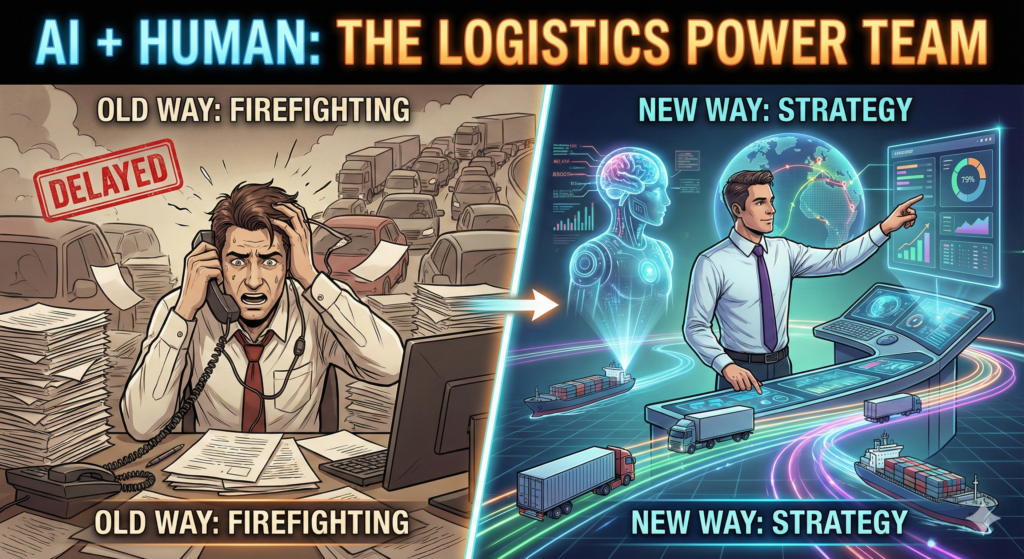
Be honest with yourself—how much of your day is spent on “real management” versus “firefighting”?
- How many hours do you spend copy-pasting data from Excel to email?
- How much time do you spend calling drivers just to ask, “Where have you reached?”
- How often do you argue about billing discrepancies that turn out to be simple typos?
This is not management. This is administration. And this is exactly what AI is coming to take away.
What AI Is Actually Good At (The “Boring” Stuff)
To understand why you are safe, you need to understand what AI actually does. AI is not a human brain. It is a calculator on steroids. It is fantastic at three things:
1. Crunching Massive Data
If you give a human 500 spreadsheets of shipping data and ask for the cheapest route, it will take them a week. AI can do it in 3 seconds. It can analyze traffic patterns, weather, fuel costs, and vehicle availability instantly.
2. Spotting Patterns
AI can notice things we miss. It might notice that “Every time we use Vendor X for shipments to Bangalore on a Friday, there is a 20% delay.” A human might miss that pattern because we are too busy; AI never sleeps and never forgets.
3. Repetitive Tasks
Generating invoices, updating tracking statuses, sending “Out for Delivery” SMS alerts—these are tasks that require zero creativity. AI loves these tasks.
So, if AI takes these tasks, what is left for you?
The answer: Everything that matters.
The “Human Edge”: What AI Can’t Do
Logistics is not just a math problem. If it were, we would have automated it 20 years ago. Logistics is a people business. It is messy, unpredictable, and emotional.
Here are the three superpowers you have that AI will never have:
1. Negotiation and Relationships
Imagine a shipment is stuck at customs. Papers are missing. The official is being difficult.
- The AI will send an automated email saying: “Error: Code 404 – Documents Missing.” It stops there.
- The Human Manager (You) picks up the phone. You call your contact at the port. You explain the urgency. Maybe you have a longstanding relationship with the clearing agent. You use your tone of voice, your history, and your persuasion to get the job done.
Business is built on trust, not code. AI cannot build a relationship with a vendor so that they prioritize your cargo during a crisis.
2. Handling “Chaos”
AI is great when things follow the rules. But in logistics, rules are broken every day.
- A truck tire bursts in a remote village.
- A sudden strike blocks a highway.
- A client changes their delivery address while the truck is already on the road.
AI panics in chaos because it has no “historical data” for a brand-new crisis. Humans are masters of “Jugaad” (creative problem solving). We can think on our feet. We can make a decision that might not be “mathematically” perfect but is the right thing to do to save the client relationship.
3. Empathy and Customer Service
When a client is screaming because their factory line is stopped due to a delayed part, they don’t want a chatbot saying, “Your estimated delay is 4 hours.” They want a human to say, “I understand how critical this is. I am personally tracking this, and I won’t go home until it’s delivered.”
Empathy calms people down. AI cannot offer comfort.
The New Job Description: From “Operator” to “Strategist”
So, will your job exist in 2026? Yes. But it will look different.
The Old Logistics Manager:
- Spent 70% of the time on the phone tracking trucks.
- Spent 20% of the time fixing data errors.
- Spent 10% of the time planning.
The New Logistics Manager (Powered by AI):
- 0% of time tracking (The dashboard does it).
- 0% of time on data entry (The system does it).
- 50% of time handling exceptions (The difficult problems the AI flagged).
- 50% of time on Strategy.
What is Strategy?
Instead of just moving boxes, you will start asking bigger questions:
- “Should we open a new hub in Nagpur to reduce delivery times?”
- “How can we renegotiate our contracts with carriers now that we have data showing their performance is poor?”
- “How can we improve our packaging to reduce damages?”
You become a consultant to your own business. You stop being the person who puts out fires, and you become the person who builds a fireproof house.
How to Prepare (Don’t Be the Dinosaur)
The only managers who are at risk are the ones who refuse to adapt. If your value to the company is “I am the only one who knows how to update this specific Excel sheet,” you are in trouble.
Here is how to future-proof your career right now:
- Stop Hating the Tech: When your company introduces a new software or GPS system, don’t complain. Be the first one to learn it. Become the “Super User.” If you control the machine, the machine works for you.
- Focus on Soft Skills: Work on your communication, negotiation, and leadership skills. These are the skills that cannot be coded.
- Learn to Read Data: You don’t need to be a programmer. But you need to know how to look at a dashboard and understand what the numbers are telling you. AI gives you the data; you have to make the decision.
The Verdict
Let’s go back to the original question: Will AI replace Logistics Managers?
Think of it like an airplane. Modern planes can fly themselves. They can take off, cruise, and land on autopilot. The computer is faster and more accurate than any human pilot.
But when you get on a plane, do you want an empty cockpit? No.
You want a pilot up there. You want a human monitoring the systems, ready to take control if there is a storm, and making the critical decisions that keep everyone safe.
You are the pilot.
AI is just your autopilot. It handles the boring, long hours of flying in a straight line so you can focus on the destination.
So, take a deep breath. Your job isn’t disappearing—it’s getting an upgrade.
Did you find this helpful? Share this with a colleague who is worried about AI!